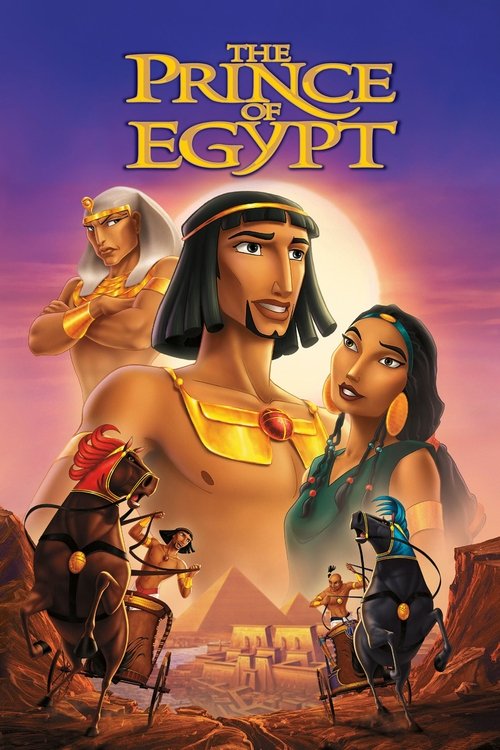
The Prince of Egypt
Released: 1998-12-16
The strong bond between two Royal Egyptian brothers is challenged when their chosen responsibilities set them at odds, with extraordinary consequences.
Adventure
Animation
Drama
Family
7.3 / 4431
Duration: 99 min.
Budget: $70.0M
Revenue: $218.6M
Trailer
Gallery
Reviews

CinemaSerf
Rating:7/10
So if you’ve seen Charlton Heston and Yul Brynner have at it in Cecil B. DeMille’s epic from 1956, then you’ll have a rough idea of what this is about. Rameses is heir to the Pharaoh Seti but is usually just getting himself involved in some mischief with his half-brother Moses. The pair are as thick as thieves, but the King knows that his son has to mature if he is to wear the two crowns, so gives him a regency and more responsibility. The first thing he does with that is to appoint his brother chief architect and with a city to build, that gives Moses a chance to get out amidst the slaves who makes the bricks. That’s when he gets quite a shock that rocks him and his brother to the core. Aware, now, of his true provenance he must lead his newfound people to safety - and that is not a plan the now new Pharaoh can support. With these hitherto loving siblings now at loggerheads it is up to the conflicted Moses to cross the Red Sea. Now not wishing to get all philosophical here, but it did strike me as rather odd that a culture that built the pyramids and the great city of Thebes should somehow have been expected to surrender it’s workforce to a glorified goatherd whose God was every bit as brutal and ruthless as those of the society they wished to leave. Let my people go or I shall murder every one of your first born infant sons! Hmmm, sound fair to you? I don’t recall anything from Horus, or Isis, or Ra espousing the routine slaughtering of innocent children if they didn’t get their way - and all the Hewbrews were being offered instead were some goats, tents and a very long trek through an arid desert so they could build another temple! Anyway, for Moses and his folks this relocation offer proves way more attractive than treading straw into mud so off they set and as per the biblical Exodus, the story unfolds. Where this does differ from the earlier Hollywood iteration is that it suggests way more of a struggle from Ramses and Moses to see a parting of the ways. It shows us a genuine affection between these two men as they must each reconcile with their diverging fates. Some of the dialogue did remind me of “Braveheart” (1995) but that didn’t have Hans Zimmer and Stephen Schwartz writing the tunes - including the power ballad “When You Believe” from the combined dulcets of Mariah Carey and Whitney Houston! The quality of the animation is a little two-dimensional, but there are plenty of emotive facial expressions and the action sequences towards the end are impressive. Bible purists might notice a few abridgements but it’s none the worst for simplifying a characterful story - and with some style, too.
Hover to reveal
badelf
Rating:8/10
**The Prince of Egypt (1998)** _Directed by Brenda Chapman, Steve Hickner, and Simon Wells_ The animation in The Prince of Egypt, considering it was last century, was quite amazing and luscious. DreamWorks created something visually stunning, epic in scope, using the medium to capture the grandeur of ancient Egypt and the intimacy of Moses' journey. The all-star cast of voices was impressive: Val Kilmer as Moses, Ralph Fiennes as Rameses, with Michelle Pfeiffer, Sandra Bullock, Jeff Goldblum, Danny Glover, Patrick Stewart, and Helen Mirren rounding out the ensemble. They brought weight and humanity to characters that could have been flat archetypes. But never mind the religious context. This is a currently relevant story about resistance against a despot. According to David Graeber and David Wengrow, authors of The Dawn of Everything, just moving away is the first primary freedom of humankind, and one we seem to have been remiss in holding onto. They write: "Over the course of these chapters we have instead talked about basic forms of social liberty which one might actually put into practice: (1) the freedom to move away or relocate from one's surroundings; (2) the freedom to ignore or disobey commands issued by others; and (3) the freedom to shape entirely new social realities, or shift back and forth between different ones." The Exodus story is the archetypal narrative of that first freedom. A people enslaved by authoritarianism choosing to leave, to relocate from conditions of oppression, to refuse the system that claims ownership over their bodies and lives. Moses leading the Hebrews out of Egypt is not just a religious parable; it's a political act, the assertion that no despot has the right to prevent people from leaving. That freedom, to move away, remains under assault everywhere: borders, walls, immigration restrictions, all designed to trap people in places where they can be controlled and exploited. The Prince of Egypt reminds us that sometimes the most radical act of revolution is simply refusing to stay.
Hover to reveal